Pavel Kuzko ← Back to the short version
G / The long version

Pavel Kuzko

Senior AI Product Manager

Belgrade, Serbia. Open to remote and EU relocation, two weeks notice.

Download CV ↓ pavel.kuzko@gmail.com LinkedIn GitHub

I have spent fourteen years turning manual work into systems. The last three of them with AI.

Product across fintech, insurance, logistics and legal, in Russia, the UK and now Serbia. Five industries, two companies I co-founded and both eventually closed, and three years shipping AI that runs in production and gets measured: retrieval cascades, voice agents, scoring systems.

I write the Python and the SQL myself. That is not the interesting part. The interesting part is that it lets me tell which half of a plan is fantasy before the sprint starts.

01 / Now

TgSight

Product Manager, AI and ML data productsOct 2023 – presentRemote

Telegram audience analytics. I am the PM on the B2B and AI/ML data side: the classification pipeline that turns raw message data into B2B signals, and the product lines sold on top of it.

7% → 1.6%
error rate, over five rounds of evals

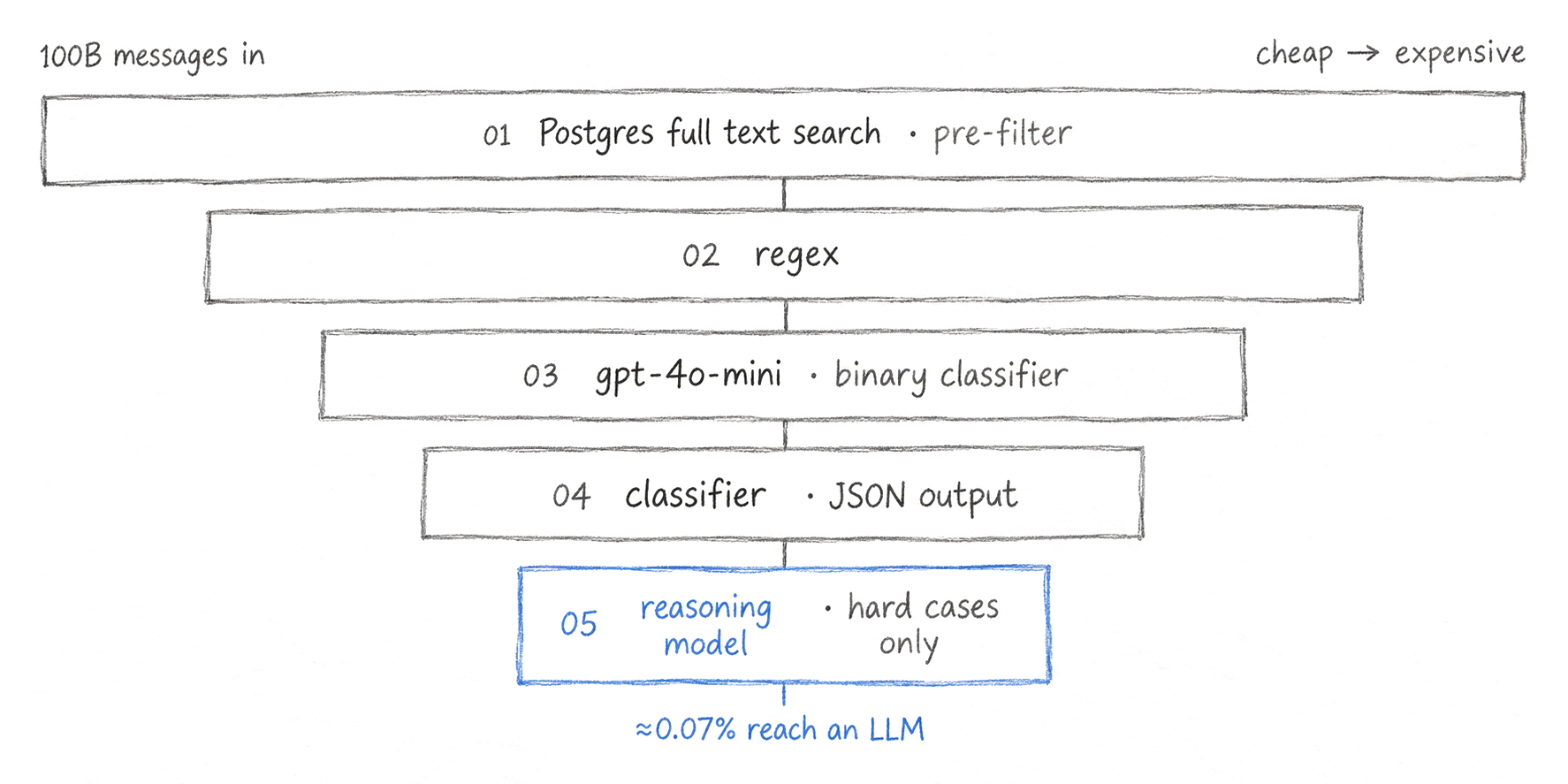
The retrieval cascade. Five stages for B2B event detection, running on our own embeddings across 100 billion messages and 12,000 topic categories. Postgres full text search and regex strip the noise first, so the LLM stages ever see about 0.07% of messages. 95% accuracy on a labelled holdout, at tens of millions of messages a month.

The eval program. Five versions of the classification pipeline measured against roughly 1,070 hand labelled messages. I set the KPI and the pass bar.

Three B2B product lines, from zero. An ML interest profiler, behavioural profiler history, channel audience insight. I owned go to market on each and made the post launch call: continue, expand or cut.

A Telegram Ads targeting system, in progress. An agent takes a natural language brief, works through the interest directories and decides which categories to target and which SQL runs underneath. Langfuse for tracing.

The cascade is the piece I would want to be judged on, so here it is in full.
Five-stage retrieval cascade: Postgres full text search, regex, gpt-4o-mini binary classifier, classifier with JSON output, reasoning model for hard cases. About 0.07% of messages reach an LLM.

Cheap filters first, expensive models only where they earn it. That is the whole trick, and it is why the thing is both accurate and affordable.

Read the full case study →
PythonDjangoCeleryPostgreSQL, 350M+ rowsDockerembeddingsLangfuse
02 / Selected work

Sterling Law

AI Product LeadLondonNov 2024 – Feb 2026

First technical hire at a Legal 500 immigration firm. I owned the AI voice intake system end to end: vendor choice, prompt design, integration architecture, rollout and the success metrics.

60%
of phone work now runs without a human

Built the voice intake agent on VAPI. It handles case status lookups, intake triage and appointment scheduling, wired into Clio CRM and an Asterisk PBX.

Designed the evaluation framework for call handling quality. It caught the regressions during a model swap, before clients did.

Split the model routing: gpt-4o-mini on the hot path at p95 around 600ms, the full model only on the hard 15% of calls. I validated that split on 200 call transcripts before it shipped.

Case turnaround dropped by roughly 30%, and the routing split took about 80% off the token bill.

Read the full case study →

Bug Free Immigration

Co-founder and Product LeadLondonJun 2023 – Nov 2024

I co-founded an immigration consultancy and built the AI applicant evaluation product. The numbers below are real. The company closed anyway, which is its own lesson and I am happy to talk through it.

8% → 18%
conversion after I shipped it

Built applicant scoring as retrieval over 10,000 historical visa cases feeding the LLM assessment. The model scores every lead, consultants review and overrule the edge cases.

Automated the rest of the funnel: intake, CV evaluation, CRM workflows and nurture.

Lead qualification accuracy went up 45%, and manual operations went from 40 hours a week down to 8.

Read the full case study →

03 / How I choose tools

A lot of AI work fails because someone reached for the fanciest tool available rather than the one that fit.

regex and rulesFixed, predictable patternsCheapest and fastest. If the rule is stable, an LLM only adds cost, latency and a chance to be wrong.
Python pipelinesMoving and reconciling data between systemsDeterministic, testable, auditable. The backbone most AI workflows need underneath and rarely have.
classic ML scoringRanking, fraud, eligibility, segmentationWhen there is labelled history and you need calibrated, explainable scores instead of free text.
an LLMLanguage, ambiguity, judgementTriage, drafting, classification of messy input. Gated behind cheaper filters, with a human wherever a mistake costs something.
RAGAnswers have to be grounded in your dataWhen the model needs your documents, policies or history to be right. The applicant scoring above is exactly this.
a cascade of all of itHigh volume, where cost and accuracy both matterCheap filters first, expensive models on the hard cases only. How the TgSight pipeline hits 95% without burning the budget.

On the technical side, so you can calibrate: I write Python (FastAPI, Django) and the SQL myself, including on Postgres datasets past 350 million rows. TypeScript front ends I ship with an AI assistant, and I would rather say that than claim I have shipped on it.

04 / Where else I have worked
2022 – 2023
TransContainerSenior Project Manager

Russia’s largest intermodal operator, over a billion euro in revenue. Redesigned IT support end to end on Camunda BPM and an enterprise service bus, and owned the roadmap for the internal operational tools. Managed the support team, then a 1C development team of ten. Ran incident coordination and owned the escalation paths.

2021 – 2022
PromsvyazbankProduct Owner

Top tier Russian bank. Built the insurance renewal product from zero: Django CRM with policy expiry tracking, API data enrichment, pre-calculated offers and automated sales leads. Managed the sales teams behind it.

2019 – 2021
RosgosstrakhProduct Manager

One of Russia’s largest insurers. Took a car owner ecosystem from concept to production: video consultation for mechanics, a multi partner integration layer and a service marketplace.

2018 – 2019
Balance PlatformProduct and Delivery Manager

Loan as a Service fintech. Built the borrower verification flow across multiple data sources including government integrations, fanning the checks out as async Celery tasks, plus the credit decisioning system that made the lending call on top of it. Ran a team of fifteen.

2016 – 2018
SberbankProduct Manager, mobile delivery

Russia’s largest bank. Built mobile delivery for the Person Around Car ecosystem across several product teams.

2014 – 2016
Odlar Yurdu SigortaCo-founder

My first company. Built and ran the digital side of an insurance brokerage in Baku: carrier integrations and CRM. Closed eventually, but this is where the founder instinct started.

2012 – 2014
SoglasieClaims adjuster, then analyst, then lead PM

Where it started. I settled motor claims by hand, then drew the whole settlement process in Visio to see where the time was going. Then I built things: the loss adjuster service from the process up, the field surveyor operations, and the system those surveyors generated vehicle damage inspection reports in.

On the side
xR2 ↗

An open source prompt management platform: versioning with draft, staging and production stages plus rollback, an A/B testing engine, and conversion funnels that attribute outcomes per variant, so you can see which prompt actually converted rather than which one reads better. I wrote and published its n8n node too. It is no longer in development.

05 / How I got here

I started in 2012 settling motor insurance claims by hand. That is the repetitive coalface work I have spent the rest of my career turning into systems. I moved to mapping those processes, picked up Lean and Six Sigma, drew the whole claims flow in Visio just to see where the time went. Then I started building the systems I used to only describe.

The domains changed: insurance, banking, logistics, legal, data. The tools changed too, from Visio to Python to LLMs. The work never did. Someone is doing repetitive work that should be a system, and I build the system.

I have co-founded two companies and both closed. Those two years taught me more about product than a decade of safer roles did, mostly about how quickly a good product runs out of runway when nobody has thought hard about who pays for it.

What I want next is a product role at a company building AI, where the hard part is the system rather than the slide about the system.

06 / Contact

Let’s work together.

EMAILpavel.kuzko@gmail.com
LINKEDINlinkedin.com/in/pavel-kuzko
GITHUBgithub.com/xirukmfc
CVDownload as PDF
BASED INBelgrade, Serbia, as a legal resident
AVAILABLERemote or EU relocation, two weeks notice
LANGUAGESEnglish C1 (IELTS 7.0), Russian native